
Айвазовский биография на английском языке
Краткая биография Айвазовского на английском языке представлена в этой статье.
Иван Айвазовский биография на английском языке
Ivan Konstantinovich Aivazovsky was a Russian Romantic painter.
сvan Konstantinovich Aivazovsky (Hovannes Aivasian) was born on July 29, 1817, in Feodosia, Crimea, Russian Empire, into a poor Armenian family. His father was a modest Armenian trader. His mother was a traditional homemaker. His early talent as an artist earned him a scholarship to study at the Simferopol gymnasium. From 1833-1839 Aivasovsky studied at the Academy of Arts in St. Petersburg, where he was a student of professor Mikhail Vorob’ev, and graduated with the Gold Medal.
Aivazovsky was sent to paint in Crimea and in Italy, being sponsored by the Russian Imperial Academy for 6 years from 1838-1844. His numerous paintings of Mediterranean seascapes won him popularity among art collectors, such as the Russian Czars, the Ottoman Sultan, and among the various nobility in many countries. His dramatic depiction of a sea storm with the survivors from a shipwreck, known as ‘The Ninth Wave’ (1850), made him extremely famous. The original canvas is in the State Russian Museum in St. Petersburg. He also made many variations and repetitions of this particular painting, as well, as of his other popular works.
Aivazovsky produced over six thousand paintings of variable quality over the course of his long life. Most of his works were made on a longstanding commission from the Imperial Russian Navy Headquarters, where he worked for the most of his life, from the 1840s until 1900. He earned a considerable fortune, which he spent for charity, and also used for the foundation of the first School of Arts (in 1865) and the Art Gallery (in 1889) in his home town of Feodosia.
Aivazovsky was a member of Academies of Rome, Florence, Stuttgart and Amsterdam. He died on May 5, 1900, in Feodosia.
Ivan Aivazovsky
Ivan Aivazovsky
When Aivazovsky began his career, Russian art was still dominated by Romanticism and it was the romantic mood which set the terms for Russian landscape painting in the second half of the nineteenth century. It is scarcely surprising then to discover romantic elements both in Aivazovsky’s early works, and in the majority of his later ones. One reflection of this is his choice of subjects again and again we find him depicting shipwrecks, raging sea battles and storms.
Aivazovsky continued in the tradition of the great Russian landscape painters of the early nineteenth century without recourse to imitation. He created a new tradition, a new school of painting, thus making his mark on the marine painting of his own and subsequent generations.
Apart from his work as an artist, Aivazovsky was a tireless and versatile public figure: he took an eager interest in world events and sympathized deeply with small nations struggling for their independence. At the same time he worked selflessly for the good of his native town Feodosiya and did much to assist young artists.
Aivazovsky was born on 17 July 1817 (29 July New Style) in the ancient Crimean town of Feodosiya, where his father, an Armenian by nationality, had settled at the very beginning of the century. His father was a relatively well-educated man who knew several oriental languages, and who, though a trader of small means, played a significant part in the commercial life of the town. Unfortunately the plague epidemic which hit Feodosiya in 1812 wrecked his business, and when the future artist was born, the family had indeed fallen on hard times. There is some evidence to suggest that poverty obliged the young Aivazovsky to work in the cosmopolitan coffee-shops of Feodosiya, alive with the chatter of many different tongues: Italian, Greek, Turkish, Armenian and Tartar. The young boy’s eager mind soaked up all the colourful sights and sounds which Feodosiya with its mixed population had to offer. He also had a keen musical ear and soon learned to play folk melodies on the violin. Later Aivazovsky recalled some of thesemelodies for his composer friend Mikhail Glinka, who used them in his compositions. It was drawing, however, which most seized the young boy’s imagination: lacking other materials he drew in charcoal on the whitewashed walls of Feodosiya. These drawings attracted the attention of A. Kaznacheyev, the town-governor, who helped Aivazovsky to enter the high school at Simferopol and in 1833, the St Petersburg Academy of Arts.
Aivazovsky’s student days in St Petersburg coincided with a confused and in many ways contradictory phase in Russian history. On the one hand it was a period of harsh tyranical rule and political stagnation under Tsar Nicholas I, on the other it witnessed a great flowering of Russian culture, beginning after the Napoleonic War of 1812. This was the age of Pushkin, Gogol, Lermontov, Belinsky, Glinka and Briullov. Within the Academy the canons of Classicism, closely linked to ideas of civic duty and patriotism, still held sway, but the new stirrings of Romanticism were also discernible.
The great success of Karl Briullov’s picture The Last Day of Pompeii made a lasting impression on Aivazovsky, summing up as it did the victory of the Romantic school in Russian painting. Both the picture and Briullov himself played an important part in stimulating Aivazovsky’s own creative development. Furthermore, Aivazovsky was brought up in the romantic spirit by his teacher in the Academy landscape class, M. Vorobyov. In general Russian art of the first half of the nineteenth century combined Romanticism with Realism and very often both principles found expression in an artist’s works. This was especially evident in landscape painting, an essentially realist art form which continued romantic features for a long time. Aivazovsky acquired a romantic outlook in his student years and maintained it in maturity. He remained to the end one of the most faithful disciples of Romanticism, although this did not prevent him from evolving his own form of realism.
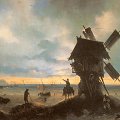 In 1836 Aivasovsky took part in training exercises of the Baltic Sea fleet on the advice of A. Sauerweid, his teacher in the battle-painting class of the Academy. Sauerweid hoped that the young artist would follow in his footsteps and become a specialist in sea battles. That same autumn his works appeared in the Academy exhibition. These student sketches show signs of outstanding talent and a mastery quite remarkable for someone in only his second year of training.
«Aivazovsky’s pictures. reveal without a doubt that his talent will take him far. Study of nature will open up to him further treasures, whose existence his talent scarcely suspects at present. » Thus wrote The Art Gazette, noting the artist’s «inherent poetic gift». One of Aivazovsky’s early canvases, The Great Roads. Kronstadt, is reproduced in this album. Although the foreground of the picture with its naively drawn human figures recalls the old Dutch masters, the perspective has breadth and depth, with spray-soaked clouds receding into the distance. The waves seem fixed and motion less, but nevertheless Aivazovsky has somehow captured the specific character of the cold Baltic Sea.
In October 1837 Aivazovsky completed his studies at the Academy and received the great gold medal, which gave him the right to a prolonged course of study abroad at the expense of the Academy. Bearing in mind the peculiar nature of Aivazovsky’s gift, the Council of the Academy took an unusual decision. To begin with the artist was to be sent to the Crimea for two summers; there he was to perfect his skills in his chosen genre by painting views of the coastal towns while sending his pictures each year to the Academy. Only after this was he to leave for Italy.
Once back in Feodosiya, Aivazovsky lost no time in setting to work. Indeed, his industriousness always surprised those who knew him, and soon a whole succession of Crimean views had appeared on his easel. His love of his native landscape was manifest in each picture.
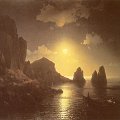 While still a student, Aivazovsky had been attracted by the romance of sea battles and the proud beauty of sailing ships. His work in Sauerweid’s class and participation in the exercises of the Baltic Sea fleet had encouraged him still further. In the Crimea Aivazovsky now had the chance to return to his favourite themes. The commander of the Caucasus Coast Line, N. Rayevsky suggested to Aivazovsky that he take part in the exercises of the Black Sea fleet. During 1839 he went to sea three times, painted a great deal from nature, and made the acquaintance of admirals M. Lazarev, V. Kornilov and P. Nakhimov. The Russian navy welcomed him with open arms and thereafter was to treat both artist and man with the greatest respect.
In the summer of 1840 Aivazovsky returned to St Petersburg before setting off on his scholarship journey. By September he was already in Rome. Here, as in Petersburg, he made the acquaintance of some of the outstanding men of the time. He became friendly with Nikolai Gogol and was on good terms with Alexander Ivanov and other Russian artists living in Rome. Not for the first time friendship with some of his most gifted contemporaries had a beneficial effect on Aivazovsky and his work.
Meanwhile he continued to paint prolifically. His pictures appeared regularly in Italian exhibitions, bringing him unusual renown. News of this got back to St Petersburg and The Art Gazette published a big article on his success in Italy:
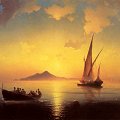 «Aivazovsky’s pictures in Rome are judged the best in the exhibition. Neapolitan Night, The Storm and Chaos have caused such a sensation in the capital of the fine arts that the palaces of noblemen and society venues are all astir with the fame of the landscape painter from southern Russia: the newspapers have sung his praises loudly and all are unanimous that only Aivazovsky is able to depict light, air and water so truly and convincingly. Pope Gregory XVI has purchased his picture Chaos and had it hung in the Vatican, where only the pictures of the world’s greatest artists are considered worthy of a place. His Chaos is generally held to be quite unlike anything seen before; it is said to be a miracle of artistry.»
The leading artists of the day recognized Aivazovsky’s mastery and talent. During a trip to Italy in 1842 the famous English marine painter, Joseph Mallord William Turner was so struck by the picture The Bay of Naples on a Moonlit Night that he dedicated a rhymed eulogy in Italian to Aivazovsky:
In this your picture
Of a mighty king!
I see the moon, all gold and silver.
Forgive me if I err, great artist,
Reflected in the sea below.
Your picture has entranced me so,
And on the surface of the sea
Reality and art are one,
There plays a breeze which leaves a trail
And I am all amazement.
Of trembling ripples, like a shower
So noble, powerful is the art
Of fiery sparks or else the gleaming headdress
That only genius could inspire!
While major artists praised Aivazovsky, others began to deliberately imitate him. In Italy, where previously there had been none, seascapes began to appear in large numbers in art shops and stalls.
Aivazovsky enjoyed equal success when he brought his pictures to Paris in 1842, having been granted permission from the Academy. The Council of the Paris Academy awarded him first their gold medal, then, in 1857, the Legion of Honour-an order rarely conferred on foreigners. Horace Vernet, the well-known French battle-painter, told Aivazovsky that his talent was a credit to his native land.
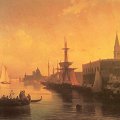 How was it that Aivazovsky entranced connoisseurs and ordinary art-lovers alike? Turner partially answered this question in his poem: it was Aivazovsky’s unusual true-ness to nature which amazed his contemporaries when they looked at his pictures; it was his ability to convey the effect of moving water and of reflected sun- and moonlight. In short it was his accurate, but at the same time highly-charged and dramatic depiction of the sea. However, Aivazovsky took some time to discover the secret of creating such impressive images. All his student years and the beginning of his foreign scholarship had been devoted to pursuit of his technique.
It is interesting to compare Aivazovsky with the Russian artist Sylvester Shchedrin, who died in Italy only ten years before Aivazovsky set foot on Italian soil. Shchedrin had broken with the academic tradition of conventional landscapes in the 1820s. His pictures had been painted directly from life and combined severe realism with a certain sense of poetry. Shchedrin was idolized by those young artists who yearned to achieve truth in their art. Aivazovsky’s favorite subject-matter was very close to that of Shchedrin, and he too was under the spell of his great predecessor. It was his aim to follow in Shchedrin’s footsteps.
The underlying principle of Shchedrin’s endeavor was to paint strictly from life. This was the way Aivazovsky had painted in the Crimea and this was the way he began to paint in Italy. Wishing to discover the secret of Shchedrin’s art, he even tried painting a landscape from exactly the same spot as Shchedrin A picture might be accurate and exact, but it would be sterile without the pulse of life within it. The viewer would see familiar places and painstakingly reproduced details, but would remain indifferent to what he saw. Instead of copying direct from nature, then, Aivazovsky tried to create a picture of the shimmering, leaping sea from memory in his studio. A miracle occurred-it was as if the sea had really begun to sparkle and shimmer, filled with incessant movement. The artist had discovered his own method of depicting nature from memory, even without preliminary studies, limiting himself to hurried pencil sketches. Justifying his method theoretically, the artist observed: «The movement of the elements cannot be directly captured by the brush-it is impossible to paint lightning, a gust of wind, or the splash of a wave, direct from nature. For that the artist must remember them. « Aivazovsky’s phenomenal power of recall and his romantic imagination enabled him to employ this method with unsurpassed brilliance. At the same time, the speed and ease with which he painted caused him to repeat himself occasionally allowing elements of cliche and salon prettiness to creep in. A pupil of the Academy, Aivazovsky could not entirely free himself of the tendency to «improve» on reality. On the whole, however, the method invented by Aivazovsky suited both his creative idiom and the spirit of the times. Very quickly he reached the peak of his fame. In the spring of 1845 Aivazovsky set off on a voyage around the coasts of Asia Minor and the Greek archipelago on a ship commanded by Admiral F. Lutke, a noted scholar and founder of the Russian Geographical Society. Once again Aivazovsky plunged into intensive work and his sketch-books were soon filled with new impressions. On his return he settled in the Crimea for a while to paint Black Sea coastal scenery and towns he had visited during the recent voyage. The pictures of this period are among his best, especially those in which he depicts Constantinople and Odessa. Here, in the shimmering gold of sky and water, the moonlit buildings, the romantic silhouettes of statues, indeed in the whole colour scheme we sense that same vision of the beautiful and exotic south which inspired many of Pushkin’s poems. The young Aivazovsky had been introduced to Pushkin at the Academy exhibition of 1836 and all his life he revered the poet. Several times he painted Pushkin standing by the sea. The best of these pictures was the one painted jointly with Ilya Repin in 1887. By the mid-1840s Aivazovsky was already thinking of settling permanently in Feodosiya, since the role of court painter held little attraction for him. He preferred to work steadily at his paintings in a peaceful provincial seaside town. Thus Aivazovsky stayed in Feodosiya for the rest of his life. He travelled occasionally to St Petersburg and visited Moscow from time to time, he made journeys to the Caucasus, along the Volga, to Turkey and to America and his exhibitions were successful wherever he went; but Feodosiya always remained his real home. It was there that he produced his best canvases. Some forty years after settling permanently in Feodosiya, Aivazovsky financed the erection of the picture gallery there which bears his name. It now houses 130 pictures and 270 sketches by Aivazovsky himself, as well as works by Lagorio, Vessler, Latri, Voloshin, Bogayevsky and others connected with the eastern Crimea, a place of ancient culture and severe but picturesque landscapes. Aivazovsky’s links with the Russian Navy grew stronger. He was revered by the Navy in a way unparalleled in the history of art. In 1846, for example, the Navy marked the tenth anniversary of Aivazovsky’s artistic career: Admiral Kornilov sent a special squadron of battleships from Sevastopol to congratulate the artist. Another of this group of pictures, entitled The Battle of the Straits of Chios, is full of inner tension. Here Aivazovsky very skillfully achieved the effect of depth by alternating the silhouettes of near and distant ships. A third picture painted at the same time is The Brig «Mercury » where the battle is already over. A small ship with battered sails is returning to the main Russian fleet (visible on the horizon) after successfully undertaking a heroic raid. In the second half of the nineteenth century realistic trends became dominant in Russian culture and did not pass by Aivazovsky. The new spirit of conscious and consistent realism had its effect on his work as on that of many others, but his romantic inclinations persisted. During the Crimean War of 1853-56 Aivazovsky spent some time in besieged Sevastopol and made some sketches there. However, this war, conducted mostly on land, found little reflection in his work, despite the fact that from this time onwards «dryland» subjects attracted his attention more and more often. He knew the endless Ukrainian steppes well because he had often crossed them on his journeys to St Petersburg. Their infinite expanses fired his imagination, and from now on we often find peasant carts in the cornfields and Ukrainian farm-houses in Aivazovsky’s pictures. During the 1860s many Russian artists of democratic inclination became interested in the peasant theme and it was probably this general trend which turned Aivazovsky’s mind in that direction; nevertheless the academic tradition in art did not allow the artist to fill his picture with the tendentious social content that characterized the real «men of the ‘sixties». The pictures painted by Aivazovsky at this time are not among his best. In the 1860s Aivazovsky turned to another subject close to his heart. In 1867 the Greeks living on Crete started a rebellion against Turkish rule. Ever since his childhood Aivazovsky had felt a special sympathy for the Greeks in their struggle for liberation, and now he painted a picture called On the Island of Crete, capturing the dramatic moment when the rebels bid farewell to their women and old folk who are being evacuated on a Russian ship. The mood of nature corresponds to the feelings of the people: over the sea there is a bright cloudless sky, but over the island the storm clouds thicken, darkening the valleys and ravines; the trees are bent by the wind-a storm is coming. Even a certain degree of melodrama in the depiction of the figures in the foreground does not reduce the overall air of tension and foreboding. In a way this reflected Aiva-zovsky’s own state, for at the age of fifty he was on the verge of a new upheaval in his artistic evolution. The final third of the nineteenth century witnessed a flowering of realism in all genres of Russian art. It was then that the members of the Society for Circulating Art Exhibitions (the Peredvizhniki) were creating their best works, and names like Repin, Kram-skoi, Surikov, Shishkin and Levitan came to the fore. Aivazovsky’s talent also took a new direction at the beginning of the 1870s. The somewhat sugary picturesqueness of his early works gave way to a more realist vision of the world. The romantic tension does not leave his pictures but takes on a sterner, more restrained character. In The Rainbow (1873) the artist uses more subtle colouration as if he had begun to look at the sea with new and more discerning eyes. The waves and spray-soaked air are painted more authentically than before. At first sight there is nothing unusual in the picture Moonlit Sea (1878)-the full moon penetrating a light cloud-cover, the line of mountains in the distance, the moon’s reflection stretching like a watery pathway, broken by ripples. But all of this is painted in a new way: the movement of the waves is more intense, there is a more imposing sense of space and the beauty of the southern night is more subtly conveyed. Aivazovsky’s greatest achievement in this period is The Black Sea (1881). Here the artist created a generalized image of the marine elements in their ever-changing manifestations. The distant horizon is calm, but towards the foreground the sea gets rougher and waves break the smooth surface of the water. In the immediate foreground the water forms great waves, crested here and there by foam. Their measured rocking movement and the vastness of the sea are conveyed with exceptional power. So far the water has only begun to seethe, yet its motion is already relentless and frightening. The fine blue of the sky is being overtaken by a dense, grey wall of clouds; coloured shadows appear on the water with dappled patches and highlights-some blue, some turquoise or pure green-just as in reality. Ivan Kramskoi, who was a discerning and sensitive critic, wrote of this picture: «There is nothing in it but sky and water, yet the water is a boundless ocean, not rough, but restless, severe, infinite, and the sky is, if possible, more infinite still. It is one of the most powerful pictures I know.» Aivazovsky maintained his capacity for work, his energy and lively creative intelligence until the very end of his life. All in all he painted more than 6,000 pictures and a multitude of skillfully executed drawings. Many of his works have taken their places among the greatest achievements of visual art. Kramskoi referred to Aivazovsky as «a star of the first magnitude» and thus correctly established the painter’s place in the pantheon of Russian art. Fate was kind to Aivazovsky, bestowing on him a clear mind and rich soul. He worked all his life in a congenial setting of his own choice; he received in his lifetime all the signs of official recognition which he deserved; his talent was universally acclaimed. From his home in Feodosiya Aivazovsky worked for the good of its inhabitants and the development of the region, taking this role very seriously. He supplied the town with water from his own estate, he opened an art school, began the first archaeological excavations in the region and built a historical museum. Finally, thanks to his efforts a commercial port was established at Feodosiya and linked up to the railway network. By these and other deeds Aivazovsky earned the love and respect of the townspeople. To this day the principal sights of the town are his picture gallery and his grave near an ancient Armenian church. Aivazovsky died on 19 April (2 May New Style) 1900, on the verge of the twentieth century, leaving unfinished a picture he had begun that same day. Whatever lies ahead for Russian art there is no doubt that the creative legacy of Aivazovsky will always be a treasured part of its history. 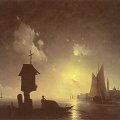 In 1844 Aivazovsky asked permission to return home prematurely from his European tour and he set off for Russia via Holland. In Amsterdam he organized an exhibition of his pictures; it was a great success and the Amsterdam Academy honoured him with the title of academician. Once back in St Petersburg the Council of the Academy also bestowed on him the title of academician and by the Tsar’s edict he was attached to the Chief Naval Staff «with the title of painter to the Staff and with the right to wear the uniform of the naval ministry». Immediately Aivazovsky was commissioned to paint views of Kronstadt, Revel (now Tallinn) and other places on the Baltic coast. By the end of the winter he had completed the commision. The result was a series of large-scale canvases in which Aivazovsky succeeded in combining accurate topographical information with a poetic mood.
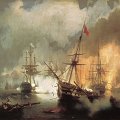 The years 1846-48 witness a series of outstanding canvases devoted to battles at sea, all based on the heroic past of the Russian fleet. These pictures betray no trace of the cliches usually adopted by official battle-artists; they convey the excitement and romantic uplift evoked in the artist’s mind by scenes of mortal conflict. This is particularly evident in The Battle of Chesme, depicting a sea battle at night. The defeated Turkish fleet set alight by a Russian fire-ship is an unusually impressive spectacle, Aivazovsky’s mastery of light effects being used to the full. Flames reflected in the clouds vie with the moonrays and the columns of smoke rising up into the sky. Crimson and black merge in the general confusion. It should be added that even in Aivazovsky’s best pictures, elements of the academic tradition made themselves felt. Here it can be detected not only in the spectacular display of the battle but in the conventional poses of Turkish sailors trying to keep afloat on fragments of their doomed ship.
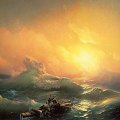 By the 1850s the romantic element in Aivazovsky’s work had become even more apparent. This is clearly seen in one of Aivazovsky’s best and most famous pictures, The Tenth Wave. A group of shipwrecked survivors is about to be engulfed by an enormous wave. The merciless pounding of the elements is brilliantly conveyed as the waves roll, rise up and crash down with full force, having revealed for a moment the deep chasm below. The restless movement of clouds and sprays of foam strengthen the impression of a raging hurricane. Despite this the people clinging to a broken mast still struggle for life-the sun has just risen and its rays pierce the watery chaos, increasing just a little their chance of survival. The essential tragedy of the picture is outweighed by the vividness of the impression it makes: the spectator understands the horror of the storm but his feelings are won over by its beauty. This duality is typical of Aivazovsky, but it was present too in Briullov’s famous picture The Last Day of Pompeii. The Last Day of Pompeii and The Tenth Wave are separated by seventeen years and differ widely in their genre as well as in their place in the history of Russian art; but stylistically they stand together and represent the rise of Romanticism both in the individual development of the two artists and in Russian art as whole.
 In the 1860s Aivazovsky visited the Caucasus. The splendour of its mountain landscapes made an indelible impression on him and he produced a whole series of pictures on Caucasian subjects. He had painted mountains before, usually with waves breaking on their gloomy cliffs, but the mountain theme appeared more and more frequently in later years. Once again the artist found romance and drama in the clash of the elements- mountain and sea. In a picture depicting the aul (Caucasian village) of Gunib the imposing reddish mountains of Daghestan rise up like fantastical frozen waves. Everything conspires to give the picture a romantic quality: the darkness of the ravines, the misty background, the mounted tribesmen on the path. At the same time the picture is strictly documentary in that it records the actual contours of a real locality, and Aivazovsky underlined this by calling his canvas The Aul of Gunib in Daghestan. View from the East.
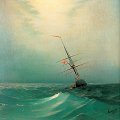 It is a rare artist who both resists old age and actually rises above his previous works. Aivazovsky achieved this twice. He painted The Black Sea at the age of sixty-four and then created the large-scale canvas of Amidst the Waves when he was nearly eighty-two. In it he painted a complicated network of waves in an endless variety of grey, green and blue shades done in light, almost transparent brush-strokes. With inimitable skill he created an image of the ocean aroused by a hurricane. Separated by deep abysses the waves thunder, collide and break into whirlpools. This vast body of water is in constant feverish motion undergoing endless transformations: here are elemental power and movement taken to the extreme. Aivazovsky had moved on a long way from the brilliance, but contrived artificiality of The Tenth Wave. This final image of the angry but beautiful sea forms a fitting climax to the great artist’s work.
Biographical Outline
Ivan Aivazovsky Art
Articles
 Art Encyclopedia A world history of art in articles.
Romanticism
Ivan Aivazovsky
Life and biography.


